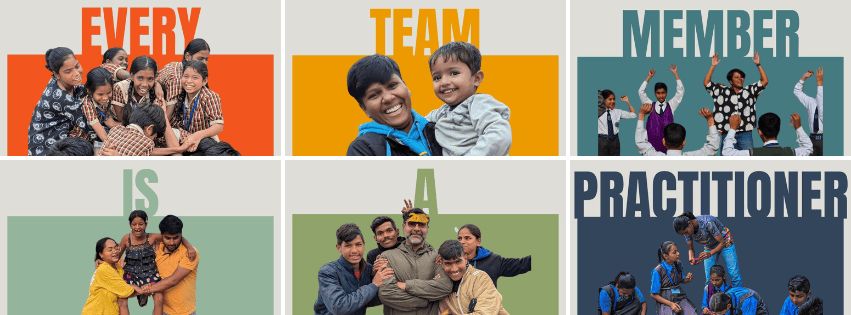
What if everyone in an organization — regardless of role or rank — was actively involved in fieldwork? What if every team member wore multiple hats, personally knew the beneficiaries, and met them regularly? What if accountability was universal, and skills weren’t confined to job titles?
At Project KHEL, that’s not a “what if.” It’s how we work. And here’s why it makes all the difference:
- Seeing Reality Firsthand
Nothing beats personal experience. When decision-makers spend time in the field, they don’t have to rely on reports or second-hand information. They witness real challenges firsthand, leading to quicker, more practical, and well-informed decisions.
For instance, we visit our program locations every day. Recently, a slum we work in had to vacate unexpectedly. In many organizations, such a situation would get caught in the hierarchy — waiting for updates, approvals, and instructions. But at Project KHEL, our facilitators have the autonomy to assess the situation and make real-time decisions that serve our beneficiaries best.
2. A Stronger Team Through Task-based Management
At Project KHEL, where everyone is a practitioner, we don’t operate through rigid hierarchies — we operate through task-based management. Roles and responsibilities are defined by tasks, not titles. This means that ownership is clear, and accountability is mutual.
Since everyone is in the field and directly involved, the question isn’t ‘who is senior?’ — it is ‘who is responsible?’ If a facilitator is in charge of ensuring the debriefing form is completed, it doesn’t matter whether the person who missed it is a manager or a newcomer. Responsibility is tied to the task, and that person is empowered to follow up, regardless of seniority.
This approach promotes real teamwork and flattens traditional power structures. A new team member might be responsible for tracking attendance, while a senior facilitator reports to them on that specific task. It’s a system that builds trust, encourages collaboration, and ensures that no one hides behind a title — everyone is equally accountable to the mission.
3. More Genuine and Powerful Storytelling
Being part of the fieldwork makes all the difference for those handling communication. The best stories don’t come from reports — they come from real experiences. When communication teams are directly engaged, they can share more authentic, meaningful stories that truly resonate.
It is like a game of Chinese whispers: by the time a story reaches the communications team, it’s often exaggerated or diluted. But at Project KHEL, this isn’t the case. One of the criteria for a communications role is also being a facilitator. This way, they witness the work firsthand and tell stories in real time, capturing stories in their truest, most natural form.
4. Gaining Trust and Credibility
Trust is built through presence. Whether it’s supporters, partners, or the community, people place confidence in organizations where leaders are hands-on and actively engaged. It signals commitment, not just in words but in action — laying the foundation for deeper, more lasting relationships.
At Project KHEL, this is lived daily. The founder attends morning practice for our FrisB(arabar) sports-for-development program every single day — even on Sundays. It’s not about supervision; it’s about showing up, consistently, for the children.
5. Leading by Example
Culture is shaped by what leaders do, not just what they say. When founders and senior managers roll up their sleeves and engage in fieldwork, it sends a clear message: no role is too senior for ground-level work. This builds a culture where contribution outweighs hierarchy, and action speaks louder than titles.
It also earns respect — within the team and beyond. People are more likely to follow when they see leaders walking the talk, not just setting expectations from a distance.
A team where everyone is actively involved in the work is stronger, more effective, and more connected to its purpose. Bridging the gap between strategy and execution doesn’t just enhance teamwork — it ensures that the work creates real impact. This approach ensures that programs aren’t reliant on upper management. Processes become self-sustaining rather than dependent on upper management. The founder’s vision is ingrained at every level of management and ultimately reaches the children.
For any organization striving to create real change, the message is simple: don’t just observe — participate.